The Follow-Up Is the Real Coding Interview: Surviving “Now Optimize It” Without Losing the Thread
Everyone rehearses the first solve. You grind the pattern, you recognize the problem, the code compiles, the example passes. And then the interviewer leans in and says the words the whole round was actually built around: “Okay — now suppose the input doesn't fit in memory.”
Interviewers moved their signal here deliberately. A first solution proves preparation, and preparation is cheap now — question banks, grind lists, and lately AI can all produce a clean first answer. What none of them can fake on your behalf is the chain: whether the solution in front of you is something you own well enough to bend when the problem bends. That is what the follow-up measures. In practice, the follow-up is the interview.
The five follow-ups, and what each one is really testing
Follow-up questions feel improvised, but almost all of them are one of five moves. Knowing which move you are facing tells you what the interviewer wants to hear first.
- The constraint change. “What if it arrives as a stream?” “What if it's already sorted?” “Ten billion rows?” This tests whether your solution is a memorized artifact or a point in a design space you can navigate. The expected answer starts with what survives the change, not with new code.
- The complexity probe. “Can you do better than O(n log n)?” Sometimes there is a better bound; sometimes the honest answer is that you are at the floor and can prove why. Both answers score — guessing does not.
- The correctness challenge. “What happens with duplicates? Empty input? Ties?” This tests whether you can execute your own code in your head. Note that interviewers sometimes challenge code that is already correct, just to see if you fold. If you traced it and it holds, saying so calmly is the strong answer.
- The trade-off interrogation. “Why a hash map and not sorting?” There is rarely a right answer here — only a defended one. One sentence of trade-off before any code is worth more than a rewrite.
- The rewrite. “Can you do it without recursion?” “In Python instead?” This tests fluency — whether the idea exists in your head independently of the one syntax you rehearsed it in.
Answering the chain without losing it
The technique that holds all five together is the same: treat your first solution as a draft you expected to revise. Concretely:
- Restate the delta before touching code. “So the array no longer fits in memory — everything else still holds?” Ten words, and you have confirmed the new problem, bought a beat to think, and shown you separate the change from the invariants.
- Name what survives. Most follow-ups invalidate one assumption, not the design. Saying “the two-pointer idea survives, the sort is what breaks” keeps the revision local — and demonstrates you know why each piece is there.
- Trade-off first, code second. One sentence on what you are giving up and getting back, then the edit. Interviewers score the reasoning; the code just confirms it.
- Keep a running changelog out loud. “v1 sorted in place; v2 streams with a heap.” The interviewer is scoring deltas, so narrate in deltas.
And then there is the move that undoes well-prepared candidates more than any algorithm: the interleaved follow-up. You finish the coding question, the interviewer detours — “tell me about a conflict with a teammate” — you spend four minutes in behavioral mode, and then: “Back to your solution — could you make it iterative?” The design was clear in your head four minutes ago. Now you are rebuilding it from memory while the clock runs, and the rebuild cost reads — unfairly — as not knowing your own code.
Keeping the thread on screen
That rebuild cost is a working-memory problem, not a knowledge problem — which makes it exactly the kind of noise a tool can remove. It is also the specific scenario the interviewco.ai live session is built around.
When a coding question comes in — spoken aloud, or captured from the coding pad with the screenshot hotkey — it can be pinned. A pinned question becomes a living answer: it stays on screen, and every follow-up streams a revision into the same card instead of spawning a disconnected new answer. “Now do it without the extra array” produces v2 of the same solution, sitting exactly where v1 was.
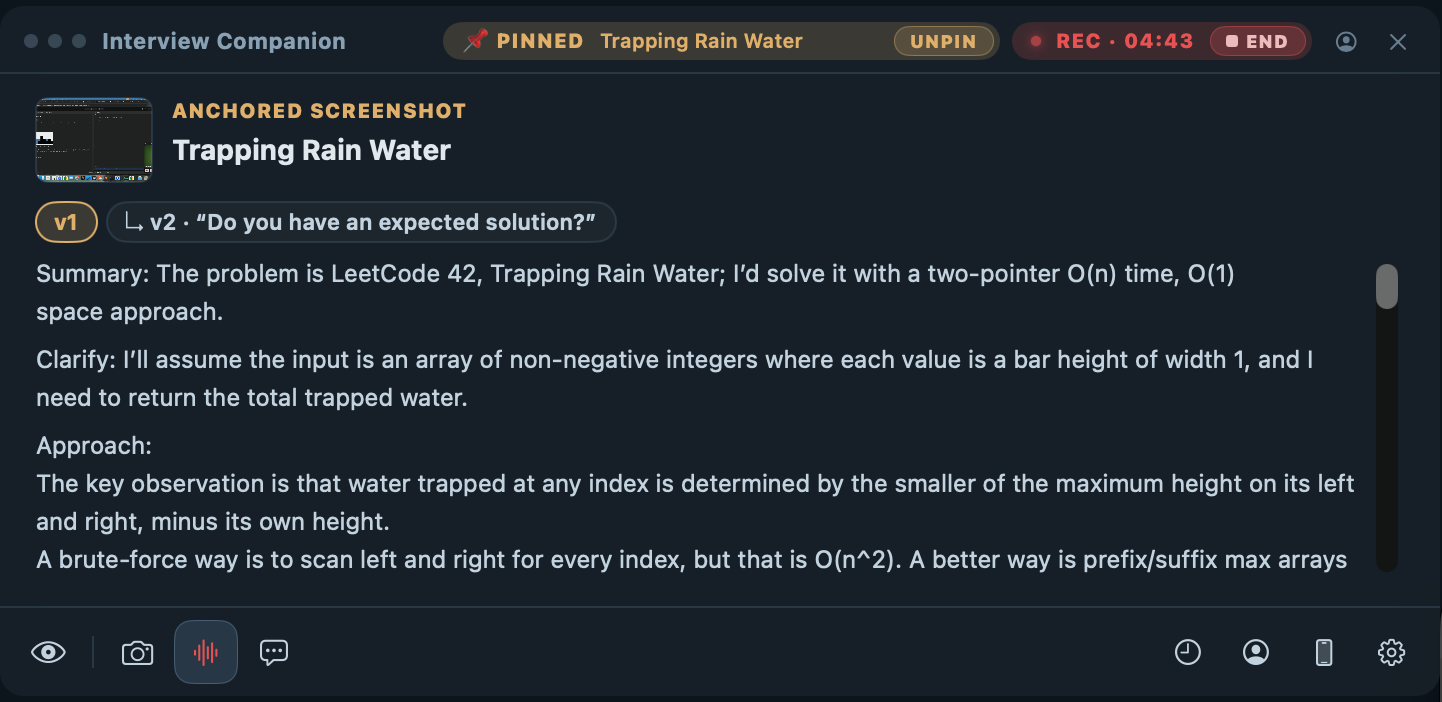
Each revision adds a version chip — flip between v1 and v2, with the changed sections marked — so when the interviewer asks “what did that change buy us?”, the delta is in front of you, not reconstructed under pressure. The behavioral detour gets its own card without stealing the pinned one, and when the interviewer says “back to your solution”, the follow-up re-attaches to the pinned question — or offers a one-tap re-pin if you had let it go. When a turn is genuinely ambiguous — is “what about duplicates?” a revision or a new question? — a short banner lets you decide instead of guessing silently.
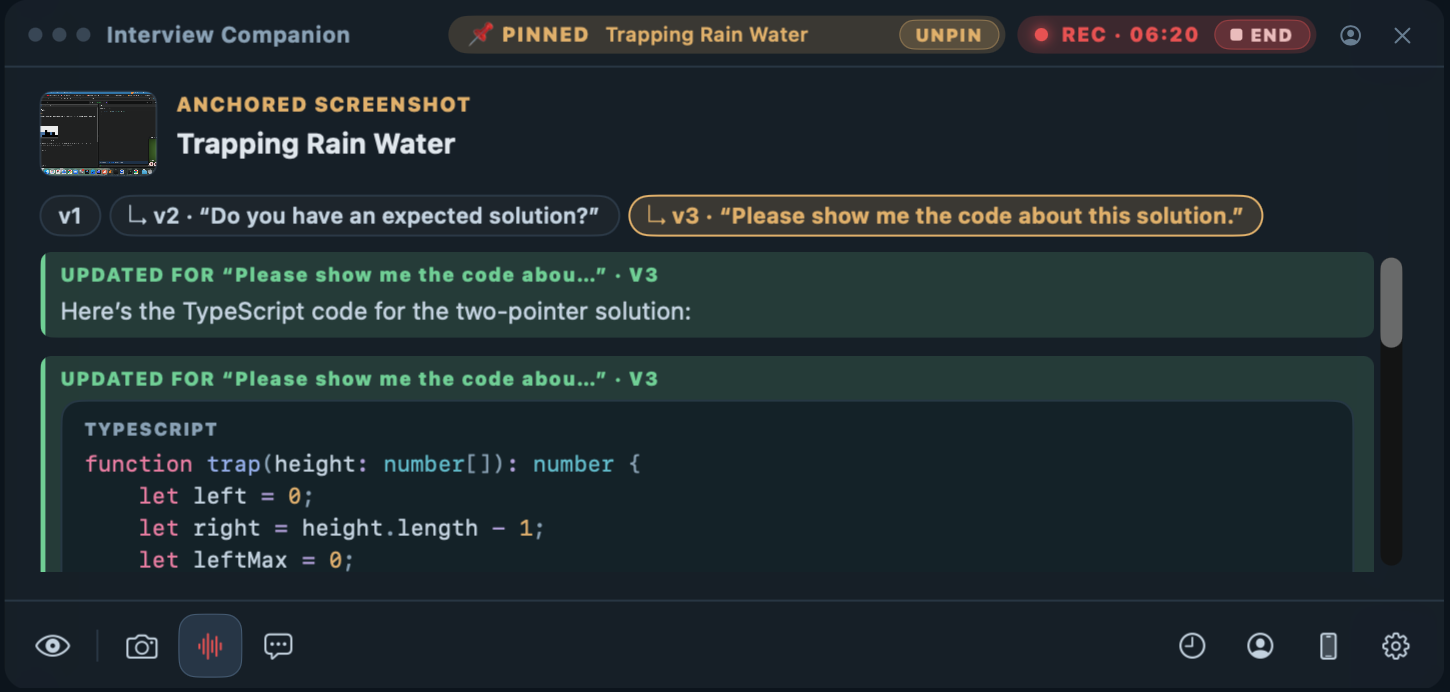
The rewrite move is covered the same way: answer code defaults to the language you picked in Settings, and an explicit “in Python, please” from the interviewer overrides it for that answer — so the v3 that lands is the rewrite that was actually asked for.
The part no tool can do
A follow-up chain is where an interviewer probes genuine understanding — that is precisely why they ask it. Keeping the draft, the versions, and the thread on screen removes the working-memory tax; it does not remove the test. The trade-off you defend, the bound you prove, the edge case you concede — those are yours, out loud, in your own words. interviewco.ai is built for real candidates interviewing as themselves: it will not sit the interview for you, and a candidate who cannot own the follow-up conversation has a problem no overlay can fix. What it can fix is losing, to a four-minute behavioral detour, a design you understood perfectly well.
FAQ
How does interviewco.ai handle a follow-up to a coding question?
A live coding question can be pinned as the anchored answer. When the interviewer asks a follow-up — a new constraint, an optimization request, an edge case — the revised solution streams into that same pinned card as a new version, instead of appearing as an unrelated new answer. The card shows a PINNED badge while anchored, and you can unpin it at any time.
What happens if the interviewer asks a behavioral question in the middle?
Interposed questions get their own cards and their own answers; the pinned coding question keeps its state. When the interviewer returns to the code later, the app re-attaches the follow-up to the pinned question — or, if you had unpinned, shows a one-tap re-pin suggestion so the revision lands on the original solution instead of starting from scratch.
Can I see what changed between two versions of the answer?
Yes. Each revision adds a version chip (v1, v2, …) on the card, so you can flip between versions. A revision also marks which sections actually changed, so you can speak to the delta — what the new constraint altered — rather than re-reading the whole answer.
What if it misreads a follow-up as a brand-new question, or the other way around?
When a spoken turn is ambiguous, the app shows a short banner with an escape hatch: keep it as a revision of the pinned question, or split it into a new question. You can also re-pin any earlier question from History. Nothing is silently discarded — every version stays reachable.
If the interviewer says “write it in Python instead”, does the answer switch languages?
Yes. Answer code defaults to the programming language you picked in Settings, but an explicit request in the question — a named language, or a question intrinsically about a specific language’s syntax or API — takes precedence for that answer.
Is this a stand-in that answers the follow-ups for me?
No. It is a preparation and live-assistance tool for real candidates interviewing as themselves. Follow-ups are precisely where an interviewer probes genuine understanding — the tool keeps the thread and the draft on screen, but the trade-offs you defend out loud are yours.