Interviewing in Your Second Language Is a Different Test
A technical interview is supposed to measure whether you can do the engineering. What it actually measures is whether you can do the engineering and perform it out loud — in real time, in a second language, while a stranger watches the clock. Then it reads the combined score as if it were only the first thing.
For a native speaker those two skills overlap enough that nobody notices the seam. For everyone else, the seam is the whole experience: you know the material cold, you would explain it to a teammate without thinking, and yet here the format keeps getting in the way of the thing you came to show.
That gap is what we kept returning to while building interviewco.ai. The goal was never to make anyone sound more impressive than they are. It was to stop the format from hiding the engineer who is already in the room.
The language tax, itemized
“Just be more fluent” misreads the problem. The cost a second language adds in a live interview is specific, and none of it is about whether you can do the job:
- Decoding burns the opening seconds. Before you can begin answering, you have to parse a fast, idiomatic question. Every second spent there is a second stolen from the part where you would shine.
- One misheard word derails the whole answer. An accent, a piece of slang, a term said quickly — and you confidently solve a problem nobody asked about. The interviewer files it under “didn't understand the question.”
- Self-monitoring eats working memory. Part of your attention is policing your own grammar and word choice — attention that should be on the system design in front of you.
Add those up and a strong engineer underperforms a test that was never really about engineering. The fix is not to fake fluency, and it is absolutely not to fake ability. It is to strip out the noise the format adds so the competence that is already there shows up in twenty minutes instead of twenty months.
Three places we take the tax back
1. You read the question instead of chasing it
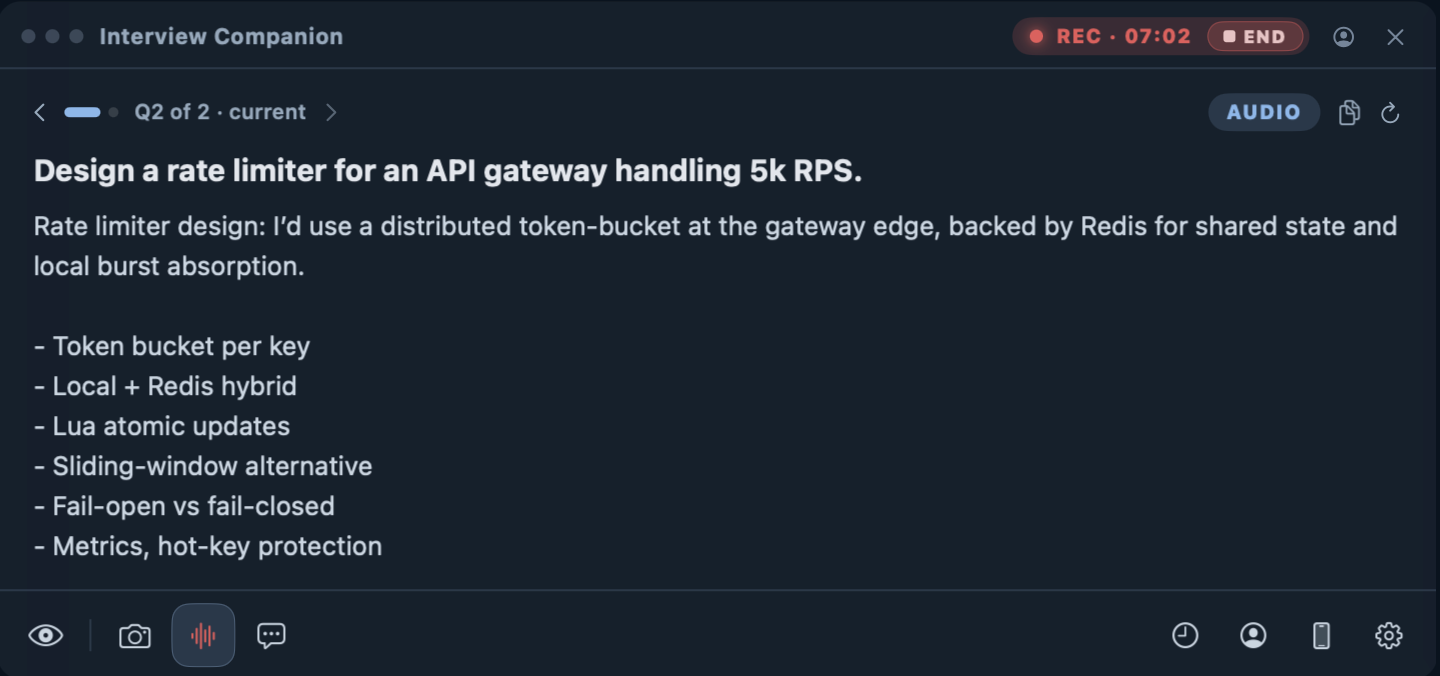
Transcription sits upstream of everything else, so it gets real work. The desktop app listens to the interview natively and transcribes each question as it is asked. Your profile's keyword set doubles as a vocabulary hint for the speech-to-text step, so domain terms — framework names, tools, the specific tech on your résumé — and accented speech come through as the right words instead of soundalikes. The decode step that used to eat your opening seconds becomes something you simply read.
2. A one-line anchor in your own language
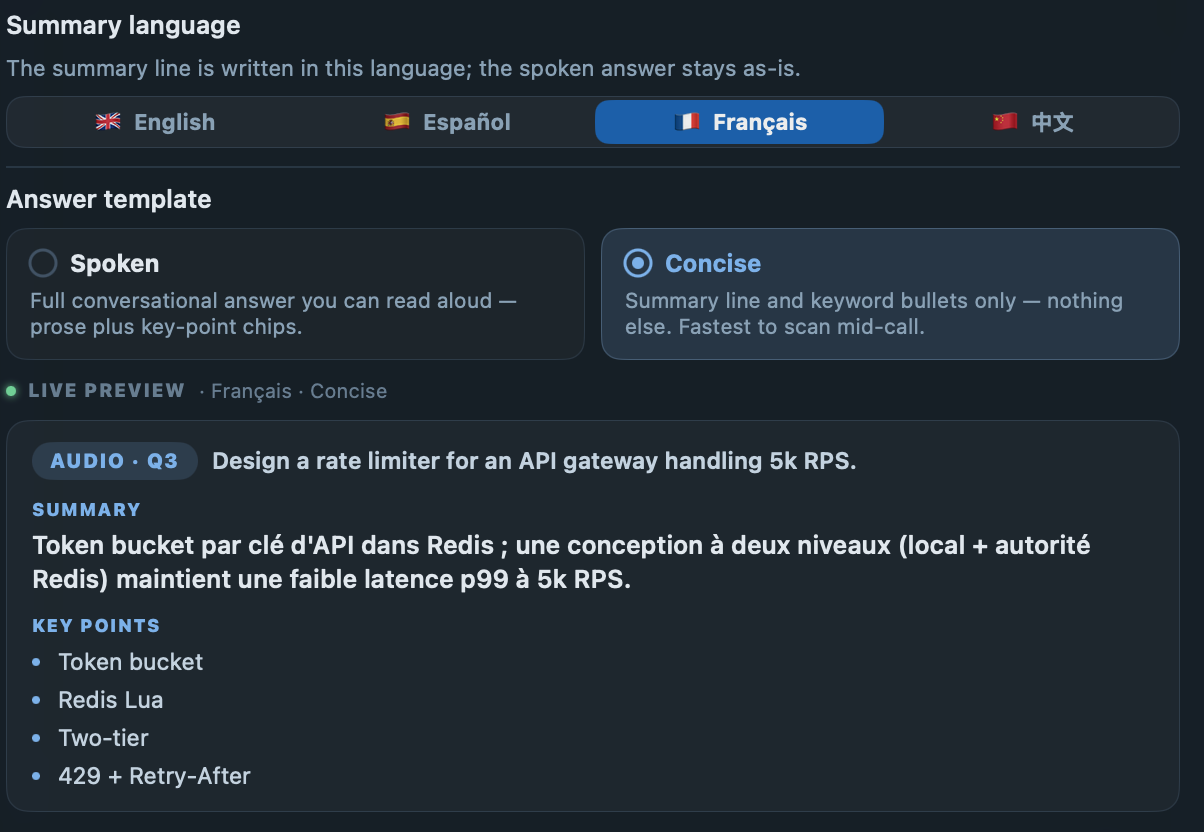
The leading summary line can be set to your language — Spanish, French, or Chinese — while the full answer stays in English. When the interviewer talks fast and you are not certain what was just asked, that single line hands you the gist, and the panic spike never lands. Crucially, only the summary line is localized: the answer you actually speak and its supporting points stay in the interview's language. It is an anchor, not a translation crutch — the words coming out of your mouth are still English, and still yours.
3. Answers carried by your work, not your accent
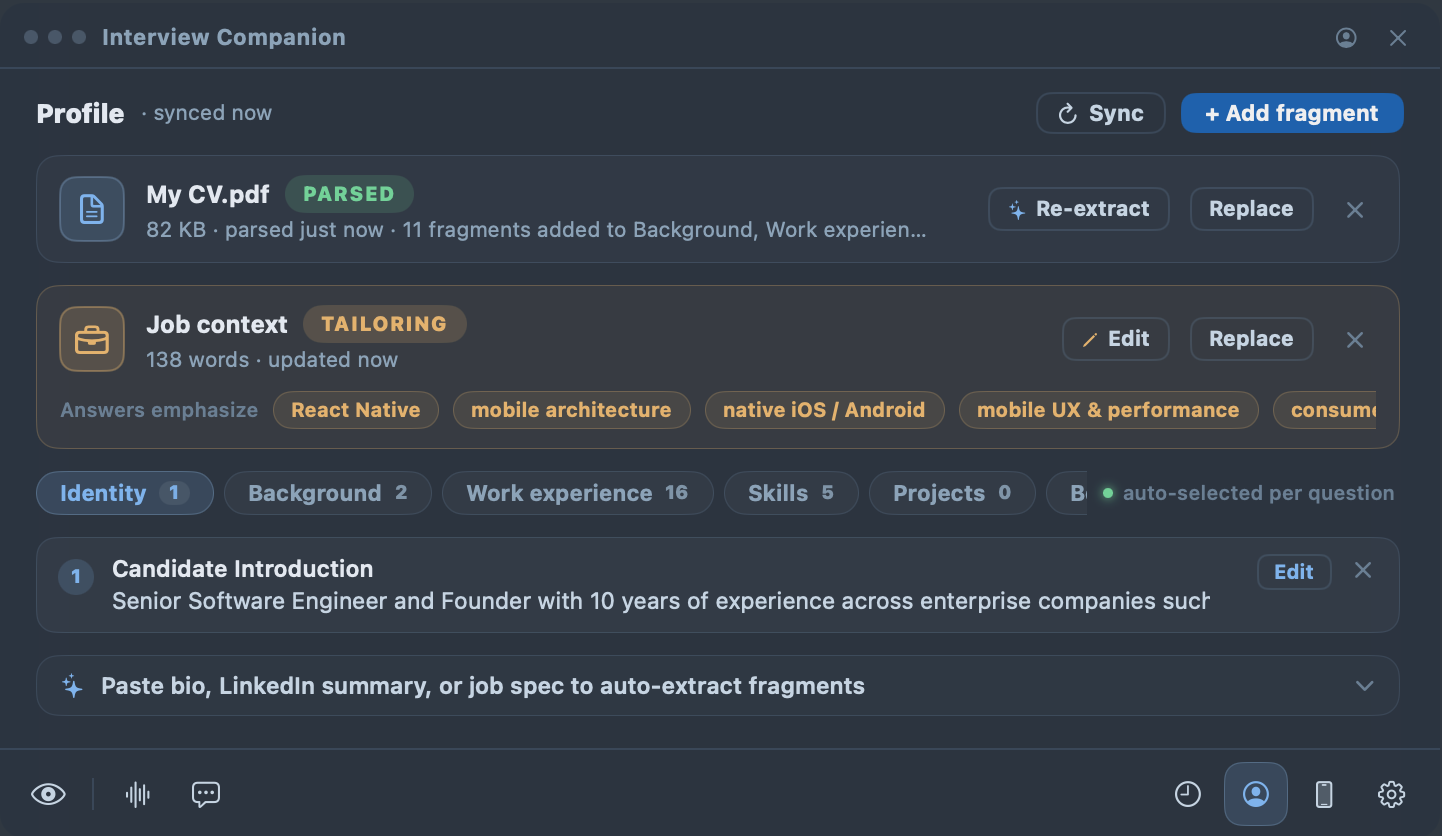
During setup, your résumé is parsed into structured fragments — the projects you shipped, the systems you built, your behavioral stories, the skills you genuinely have — and the job posting becomes role context. When a question lands, only the fragments that fit it are pulled into the answer. So the response is assembled from what you did, aimed at that role — carried by your real experience rather than by how polished your spoken English happens to be on a given morning.
The line we will not cross
Leveling a field has a hard edge, and it matters most right here: interviewco.ai will not invent ability or experience you do not have. It asks about your own résumé and helps you say what is already true, clearly, under pressure. It is not a stand-in, not a proxy, not someone else sitting your interview for you. The entire point is to make a real candidate's real competence visible — never to manufacture competence that is not there. A tool that fabricates a background is not leveling anything; it is writing a check the next twenty minutes cannot cash.
Talent is global. Fluency under a stopwatch is not the job.
Explaining your work flawlessly, out loud, in a second language, while a stranger watches the clock, is a narrow and specific skill — and most jobs will never ask you to pass that exact test again. The engineering is what carries forward, for years. The competence is already there; the interview just has a habit of hiding it behind the language.
FAQ
Can it transcribe an interviewer’s accent and technical terms correctly?
It biases speech-to-text toward the vocabulary in your active profile — the frameworks, tools, and proper nouns from your résumé and target role — so domain terms and accented speech are more likely to transcribe as the right word instead of a soundalike. The interviewer’s question is shown to you as text so you can read it rather than catch it on the fly.
Can the answer be shown in my native language?
Only the leading summary line can be localized — to Spanish, French, or Chinese — while the full answer, its supporting points, and the labels stay in the interview’s language. It is an anchor for the gist, not a translation of what you say. The words you actually speak remain in the interview’s language and remain yours.
Does interviewco.ai invent experience I don’t have?
No. Answers are grounded in a profile built from your own résumé and target job, and it will not fabricate a background, skills, or experience you do not have. It helps you say what is already true about your work, clearly, under time pressure.
Is this a stand-in that takes the interview for me?
No. It is a preparation and live-assistance tool for real candidates interviewing as themselves. It does not impersonate anyone, sit an interview on someone else’s behalf, or act as a proxy.