AI Mock Interviews That Sound Like You, Not Like a Question Bank
Most mock interviews rehearse the wrong interview.
You answer ten generic questions from a bank, feel a little more warmed up, and then walk into a room where the interviewer asks about your project, follows up on the exact trade-off you glossed over, and switches to a behavioral story you never thought to prepare. The practice did not transfer, because it was not practice for this interview.
That gap is the whole reason the interviewco.ai mock interview is built the way it is. A mock interview is a simulated practice round, and the value of one is entirely in how closely it matches the real thing — the questions, the follow-ups, the order, the pressure. So instead of a fixed question list, every session is generated from your résumé and the job you are actually interviewing for. This post walks through how it works, what the feedback looks like, and why the loop gets sharper the more you use it.
How it works, in three steps
1. Set up once: résumé in, target job in
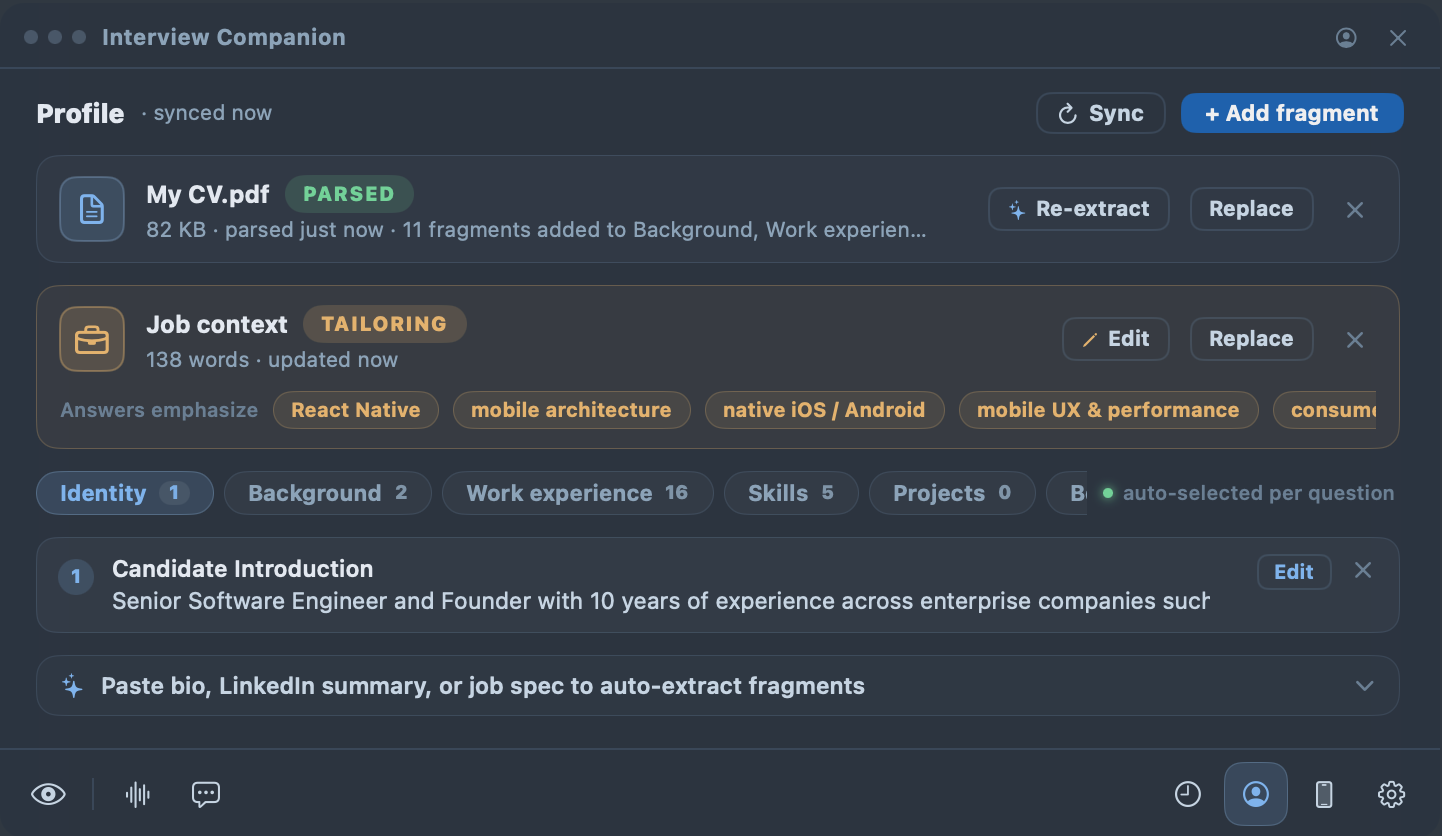
Setup is two inputs. Upload your résumé and the app extracts it into a structured profile — your experience, projects, skills, and behavioral stories, each as an editable fragment. Then paste the job posting you are aiming at, and the role context (company, role, focus areas) is extracted the same way. Pick a role track — Software Engineer, Frontend, Backend, Product Manager, Data/ML, or Designer — and from that point every mock question is anchored to your background, aimed at that job.
2. Start the mock: spoken questions, real follow-ups
The interviewer asks one question at a time, out loud, in a calm and unhurried voice — you answer by speaking, the way you will on the day. Behind each session is a structured plan that runs in the order a real loop tends to: an opening, then technical topics, then behavioral themes. The first time through, the opening is a plain “tell me about yourself.” On a return visit it skips the introduction and deep-dives one of the actual roles on your résumé instead.
The part that makes it feel real is that it does not just read down a list. After every answer the interviewer decides whether to follow up or move on. On a technical topic it asks at least one follow-up and up to three — pushing on constraints, the trade-offs behind a choice, performance, and how you would optimize next — exactly where a human interviewer would lean in. The questions stay tied to the job posting you pasted, so a backend role and a frontend role get genuinely different sessions.
3. Get feedback that names what broke
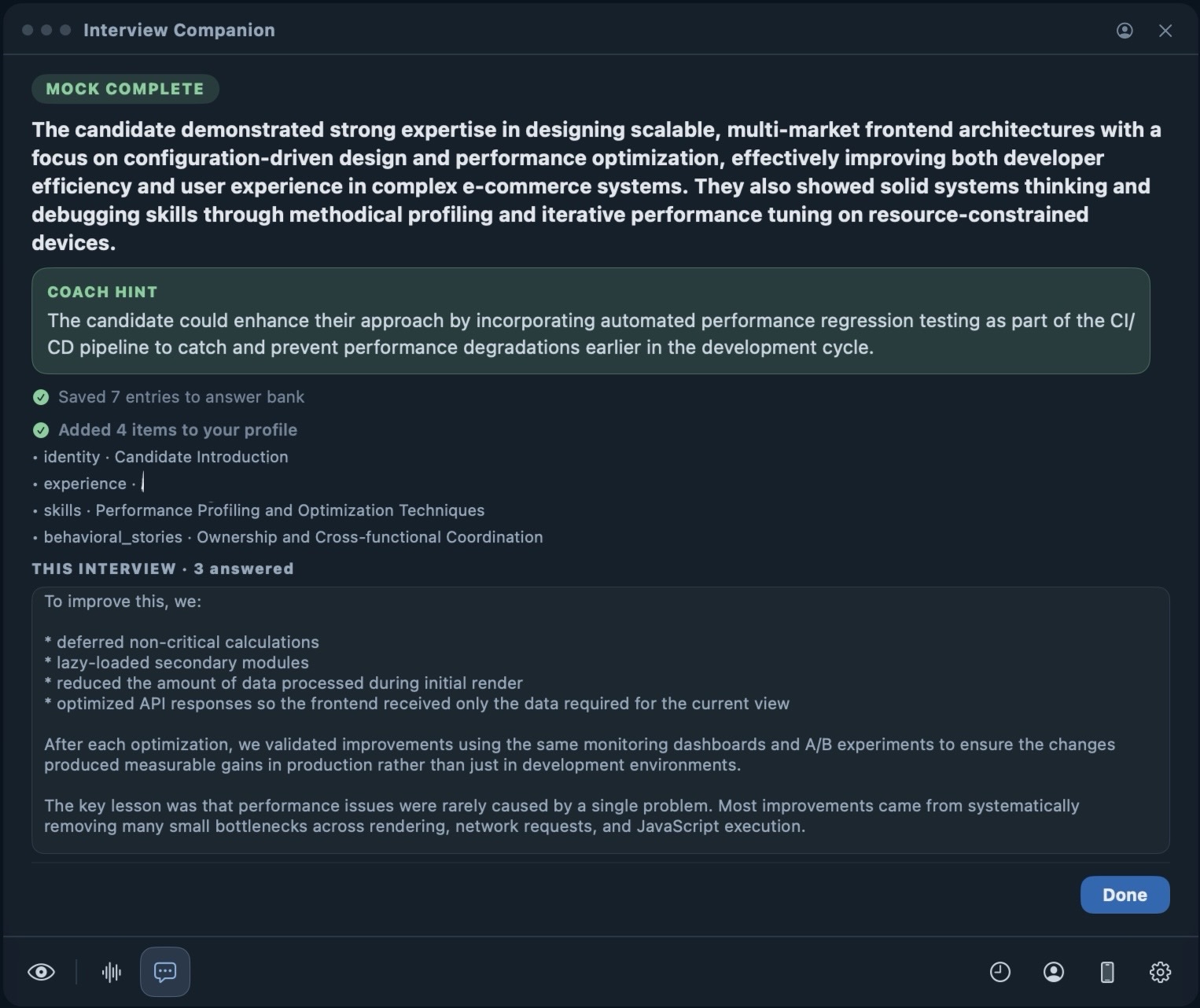
When the plan finishes, you get a written summary of how the session went plus concrete improvement notes — the spoken wrap-up is deliberately short so you are reading feedback, not listening to it. This is the “you talked, it listened” moment, and the useful version of it is specific. Instead of a vague score, it points at the things that actually cost you:
- the story was too vague
- the trade-off was missing
- the answer lost its structure halfway through
- your strongest detail was buried at the end
What makes the questions feel like yours
The structured plan is the difference between a quiz and an interview. Every session is assembled from four kinds of topic, in this order:
- Opening — a self-introduction the first time, an experience deep-dive into one of your real roles on return visits.
- Technical — one or two topics drawn from your target role's focus areas, each with adaptive follow-ups so a single topic is actually explored, not just touched.
- Behavioral — two themes drawn from a rotating set (conflict, failure, impact, leadership), chosen so you are not asked the same kind of story every session.
- Profile gaps — up to a few questions aimed squarely at the thin or empty sections of your profile. If a part of your background is underdeveloped, that is precisely the question a real interviewer is likely to expose, so the mock surfaces it on purpose. (When your profile has no gaps left, that slot becomes a second technical topic instead.)
The loop: it gets to know you
A single mock is useful. The loop is where it compounds. After each session, the interviewer distills your answers into reusable entries — tagged by theme — that become part of your own material. The next session reads that history: it rotates to behavioral themes you have not drilled yet, and it remembers that you have already done the introduction, so it digs into a different role.
Most people tell us that somewhere around the third or fourth round the feeling flips from “I hope they don't ask about X” to “I have an answer for X.” That shift — from dreading a topic to owning it — is the entire point. And because the distilled material is grounded in what you actually said about work you actually did, the answers that come out sound like you, not like a chatbot reciting a template.
A note for non-native English speakers
Interviewing in a second language adds a tax that has nothing to do with whether you can do the job: you spend energy parsing the question instead of answering it. Practicing out loud against questions tied to your own background is one of the fastest ways to lower that tax, and it is a big part of why we keep the mock interview free to start. The goal is to level the field so the interview measures your engineering, not your accent.
What it is — and what it is not
interviewco.ai is a preparation tool. The mock interview does not learn your craft for you, and it will not invent a background you do not have — it asks about your résumé and helps you rehearse your stories. It is built for real candidates preparing for real interviews; it is not a way to impersonate anyone or sit an interview on someone else's behalf.
Your résumé is some of the most personal data there is, so it stays with you: the profile lives on your computer as plain, human-readable files you can open and audit, and signing in syncs it to your own account only so your devices can see it. Per our privacy policy, we do not sell personal information, run advertising trackers, or train models on your content without your separate, explicit opt-in.
FAQ
What is a mock interview?
A mock interview is a simulated practice interview that lets you rehearse out loud before the real one. The interviewco.ai mock interview goes a step further: instead of pulling random questions from a generic bank, it builds the session from your résumé and the specific job you are targeting, so you practice the interview you are actually walking into.
How does the interviewco.ai AI mock interview work?
You set up once by adding your résumé and the job posting, which become a structured profile. Then you start a mock: the interviewer asks one spoken question at a time, following a plan that moves from an opening to technical topics to behavioral themes, with adaptive follow-ups that dig into your answers. At the end you get a written summary and improvement notes, and the strongest material is distilled and carried into your next session.
Will it feel like a real interview?
Questions are spoken aloud, one at a time, in the order a real loop tends to run: opening, then technical, then behavioral. On technical topics the interviewer asks at least one follow-up and up to three, probing constraints, trade-offs, and how you would optimize — the same way a human interviewer would rather than reading down a checklist.
How many mock interviews can I run for free?
The Free plan includes three mock interviews so you can run the full loop — questions, follow-ups, feedback — plus one real interview session so you can try the live copilot before paying anything. Paid plans open up regular practice and the live interview copilot for all your real sessions.
How do I get the most out of each session?
Treat it like the real thing and speak your answers out loud instead of typing a few words. Fill in the profile gaps it surfaces — when it asks about a part of your background that is thin, that is a question you are likely to face for real. And run a few rounds: the theme rotation deliberately covers ground you have not practiced yet, so by the third or fourth session you have an answer ready for the questions that used to make you freeze.
A mock interview is only worth as much as it resembles the real one. Build yours from your own résumé and the job you want, run it a few times, and walk in already knowing how your best answers sound.